This blog is for past and present non-government members of the National Board for Wildlife to share their official letters to government with members of the public.
Monday, 26 September 2011
Monday, 6 June 2011
Tuesday, 10 May 2011
Dr. Divyahanusinh Chavda's note
“This is with reference to the last meeting of the Standing Committee of National Board for Wildlife (NBWL). I want to bring to your attention the following:
1. a. While the agenda was circulated by email the hard copy with the maps was delivered to my house on Sunday, 24th April at Jaipur when I had already left for Delhi.
b. Additional items in the agenda were presented at the meeting itself.
2. In view of the above, I was unable to fully prepare for the meeting as I would have liked to do.
3. With regard to Parvan major irrigation project in Rajasthan, please record that I had pointed out at the meeting that nearly 2 lac trees need to be inundated/chopped for the purpose. Though I did not mention it then, I feel very strongly that proper EIA of the project must be done.
4. I would request you to kindly arrange to send the agenda well in time with maps so that one can be prepared for the discussion and contribute effectively.”
Dr.M.K.Ranjithsinh's Dissent Note to MoEF
|
Dissent note on St. Com Meeting, April 26, 2011
April 26, 2011
Re: Dissent Note on proceedings of the Standing Committee Meeting of the National Board for Wildlife on 25 April 2011
Due to the hurried manner in which the proceedings of the Standing Committee of the National Board for Wildlife (NBWL) were conducted on 25 April 2011, we would like to put our dissent note on a number of the decisions taken during the meeting, and request that these be put on record.
The Ministry’s 14 September 2010 Notification constituting the Standing Committee states that “The Member-Secretary shall prepare agenda items for the meetings, obtain approval of the Chairperson and circulate it to all members at least fifteen days prior to the date of such meeting.” In view of the above, we dissent from the decisions taken by the Committee on the additional agenda items that were sent to the members on the night of Friday, 22 April 2011, giving us not a single working day before the meeting, and no time to review and assess the items for an informed decision making process.
The decision-making process of the NBWL is hampered by the fact that maps, FAC clearances, EIA reports, etc., for all agenda items usually reach the members a day or so before the meeting, a fact repeatedly pointed out by the members. It is important that members should be able to assess the proposals and the likely impacts they will have on PAs and wildlife.
Prerna Singh Bindra
Member, Standing Committee, National Board of Wildlife
Dr Koustubh Sharma
NCF, Mysore
Member, Standing Committee, National Board of Wildlife
Prerna Bindra's dissent note on approvals, April 26, 2011
I request that my dissent note be recorded on the following proposals taken up before the Standing Committee meeting on April 25th, 2011:
On the minutes of 21st meeting of the Standing committee on January 24th 2011
4.1(13) Diversion of 3.9892 ha of forest land in Hastinapur Wildlife Sanctuary for widening of existing 2 lane of NH-24 to 4 lane road from KM 86.00 to KM 93 in Ghaziabad District, Uttar Pradesh.
It was pointed out by Ms Prerna Bindra that the area of Hastinapur sanctuary is 2079 sq km. The sanctuary has huge human habitation; there are villages, highways etc, and huge tracts have been degraded and fragmented and are known to have become of little value to wildlife. But crucially, there are still pockets which are of immense biodiversity value, with swamp deer, leopard, jungle cat, sarus cranes, Gangetic dolphins which must not be compromised. It will be prudent to have a site visit to understand which part of the sanctuary this and other proposals pertaining to Hastinapur sanctuary is being impacted by the proposals put before the committee, on the basis of which an informed decision can be made. It was assured that the area in question was not of value to wildlife, but to be on the side of caution it was agreed that a site inspection be made and after ascertaining the facts, due permission may be given subject to the following.
During the April 25th meeting, it was pointed out that clearance for the above proposal was given unconditionally during the January 24th meeting. However, I would like to place on record my dissent to a blanket clearance without verifying the area’s value in terms of wildlife/biodiversity, as specified above.
Main Agenda Items of the meeting of April 25th 2011
2[4.2(4)]: Diversion of 7.2871 ha of forest land for construction of Ropeway from Bhavnath Taleti to Ambaji Temple in Girnar Wildlife Sanctuary by Usha Breco Ltd, Ahmedabad, Gujarat.
The ropeway will pass through a known breeding site of the long billed vulture (69 vultures in 2010, an increase from the last count of 41, suggesting an increase in numbers, as against a massive decline in the state, and indeed India.)
The report by Shri Divyabhanusinh and Dr Nita Shah placed before the committee on January 24th clearly states that the ropeway, if constructed, would lead to the local extinction of the long-billed vulture Gyps indicus in North Gujarat. The critically endangered long billed vulture has seen a collapse of nearly 99% of its population, and is categorised as Critically Endangered. Ironically, the vulture is part of MoEF’s species recovery programme.
I record my dissent on the committee’s decision to clear the above proposal.
2[4(B)(12)]Proposal for denotification of forest area of Radhanagri Sanctuary for Savarde minor irrigation project.
I record my dissent on this clearance given the harmful ecological impacts, which were also discussed in the meeting. It is understood that the area to be submerged is under very good forest cover which will be destroyed irreplaceably.
2[4.1 (17)] Diversion of 0.205 ha of forest land from Fambonglho Wildlife Sanctuary for construction of Sang Naya Bazar water supply scheme from Lalichok to Sang in East Sikkim.
2[4.1 (18)] Diversion of 1.9718 ha of forest land from Pangolakha Wildlife Sanctuary for construction of water supply scheme from Mithuney to Rhenock in (South) Sikkim.
2[4.1 (19)] Diversion of 0.50 ha of forest land from Pangolakha Wildlife Sanctuary for construction of water supply scheme from Jelep la stream to Kupup in (North) Sikkim.
The decision is to allow for all three proposals, as recommended by Dr A.J.T. Johnsingh, and with the conditions imposed as in the report submitted by Prerna Singh Bindra.
I record my dissent on the decision to allow for 2[4.1 (18)], and request that my report of the site visit be placed on record.
4.1 (6) Permission for 330 MW Dholpur Gas based combined cycle thermal power project stage-II drawing water from National Chambal Ghariyal Sanctuary at Dholpur, Rajasthan
The Chambal river harbours 85 per cent of the entire population of the critically endangered gharial and a high density of the national aquatic animal, the Gangetic dolphin per river km. The ‘Assessment of minimum water flow requirements of Chambal River in the context of Gharial (Gavialis gangeticus) and Gangetic Dolphin (Platanista gangetica) conservation’ conducted by the Wildlife Institute of India categorically states that any further withdrawl of water from Chambal river will seriously affect the gharial, the wildlife and other ecosystem service values of the river.
I record my dissent on the decision to give permission for the above proposal.
Setting up of Jaypee Super Cement Plant from Clinker production 2.01 MTPA to 2.50 MTPA, 2.1 km from Kaimur Wildlife Sanctuary
My report on the above proposal may be put on record.
Proposal for denotification of entire area of Trikuta Wildlife Sanctuary (31.40 Sq. Kms), Jammu and Kashmir
This denotification sets up a very bad precedent of denotifying entire sanctuaries.
It has been decided this in lieu of the denotification another PA should be declared. As pointed out by Dr MK Ranjitsinh, such a site - double the area of the current notification - should be identified with a proper biodiversity survey, and put before the Board and first notified as a PA before any denotification of Trikuta Wildlife Sanctuary.
Proposal for diversion of 7.005 ha of protected land from Compartment No.5 of Bahu Conservation Reserve in favour of Revenue Department for leasing to the Army, in lieu of the Army land acquired by the Revenue Department.
The agreement and assurance of transferring revenue land to the army was made by the revenue department, and from the information given there seems to be no role of the forest department while giving this assurance. It was the revenue department which acquired the army land. In such circumstances it would be highly inappropriate for a Protected Area to be diverted; it will set a wrong precedent that part of a Conservation Reserve is diverted in order the meet assurances given by the revenue department.
Proposal for setting up Captive Thermal Power Plant (4x60MW) with 1 MTPA Cement Grinding Unit and 1 MTPA Coal Washery by M/s. J.P. Associates Pvt. Ltd. , 1.5 Kms from boundary of Kaimur Wildlife Sanctuary
The report for the site visit for M/s Jaypee Super Cement Plant from clinker production 2.01 MTPA to 2.50 MTPA in Kaimur Wildlife Sanctuary, Uttar Pradesh (for which my report has been submitted) records that the JP Associates flouted the Forest Conservation Act and ignored the directions of the honourable Apex court, the directions of the CEC and the directions of the regional office (Central) of the MoEF.
It came to our notice that construction has already began for the Captive Thermal Power Plant (4x60MW) with 1 MTPA Cement Grinding Unit and 1 MTPA Coal Washery, again without the mandatory clearance. A clarification and information has been sought from the concerned DFO. Also in light of the fact that a related matter of the JP Super Cement plant is subjudice (with information concealed from the Standing Committee at the time of submitting the proposal), it is judicious that this proposal be very carefully examined, before any decision is taken.
Prerna Singh Bindra
Member, Standing Committee, National Board of Wildlife
April 26, 2011
Labels:
Dissent Notes
Monday, 9 May 2011
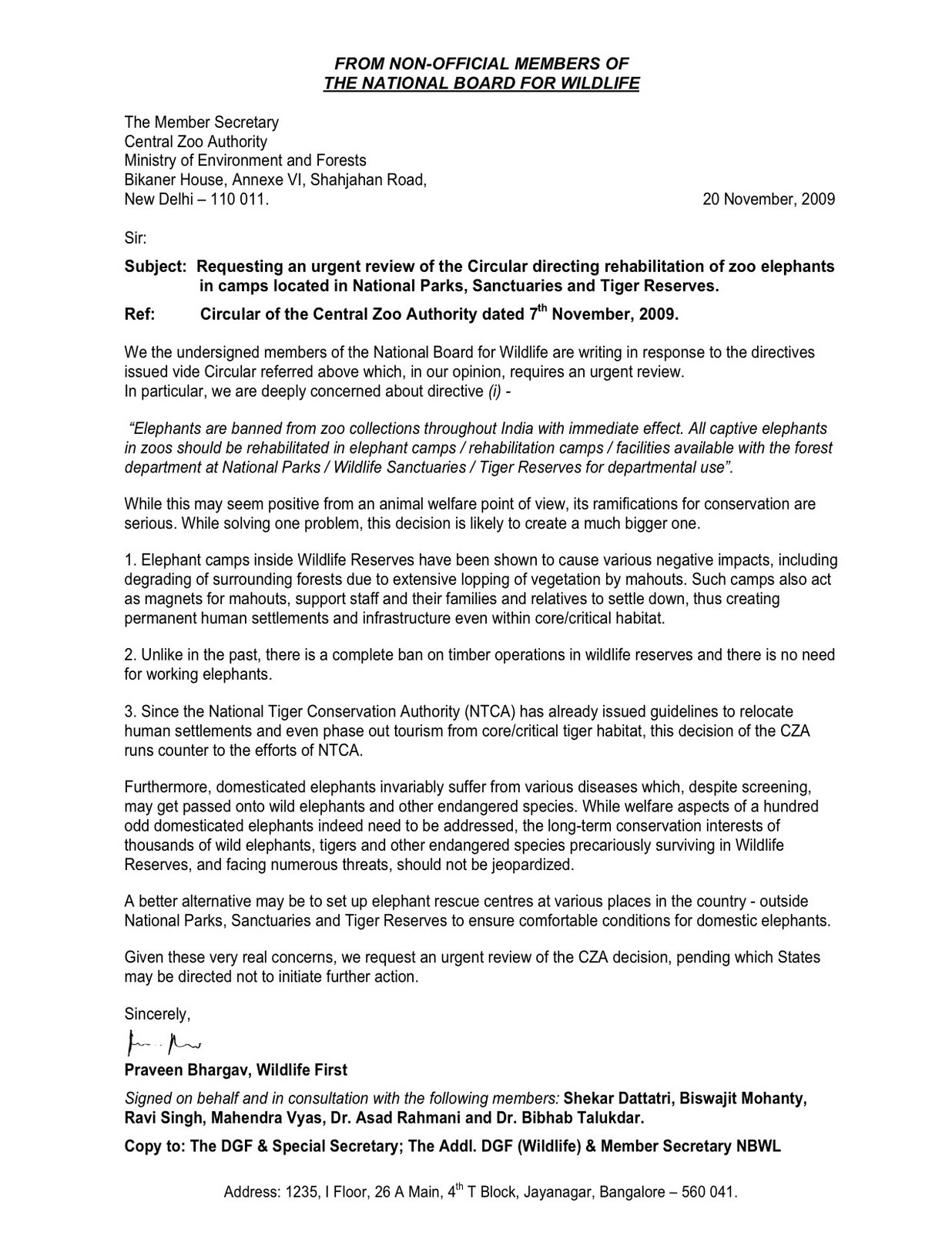
Additional Letters of previous NBWL - Rhino horn. Objection to road construction. Objection to elephant camps
----------------------------------------------------------------------------------
FROM INDEPENDENT MEMBERS OF
THE NATIONAL BOARD FOR WILDLIFE
To:
October 29, 2008
The Chairman
Central Empowered Committee
2nd floor, Chanakya Bhawan, Chanakyapuri
New Delhi 110 019
Sir,
Sub: Our Objections to new ghat road proposed through Srivilliputtur Grizzled Squirrel Sanctuary in Tamil Nadu
During its meeting in May this year, the Standing Committee of the National Board for Wildlife cleared a proposal from the Tamil Nadu Forest Department for a new 8.6 km road through the Srivilliputtur Grizzled Squirrel Sanctuary (SGSS) ostensibly for ‘protection’ of the Sanctuary. The clearance was given despite a written objection submitted to the MoEF by independent members on the Standing Committee, Dr. Divyabhanusinh Chavda, Dr. Bibhab Talukdar and Dr. Asad Rahmani.
The details of the written objection are as follows: In Dr Chavda's letter to the Ministry dated 29th February 2008, he has recorded the proceedings of the 10th meeting of the Standing Committee on 19th February 2008 and has clearly stated the following with reference to the Grizzled Squirrel Sanctuary (agenda item 3.3(9)):
"In all the above mentioned cases, the non-official members did not approve the proposals put to the Standing Committee".
However, agenda item 1 of the 11th meeting which confirms the minutes of the 10th meeting has twisted their objection by recording the following:
"Further, neither any objection from other members whose names had been indicated in the letter of Dr. Chavada had been raised regarding the minutes nor any confirmation of the stand taken by Dr. Chavada in his letter was received from them. The Chairmain also clarified that all the decisions taken in the last meeting were unanimous and it was accordingly reflected in the circulated minutes..."
We, the undersigned, who are all members of the National Board for Wildlife (NBWL), strongly object to the way this proposal for a road through a wildlife Sanctuary in the Western Ghats – one of the most important biodiversity hotspots in the world – has been bulldozed through the Standing Committee of NBWL. A note on the ecological importance of the area and the potential negative impact of the road is appended.
In view of the above facts, we request the CEC to reject the proposal of the Tamil Nadu Forest Department for construction of the road, and direct the Tamil Nadu Forest Department to take up appropriate measures including foot patrols and anti-poaching camps, to protect the area.
Sincerely,
Wildlife Protection Society of India - Belinda Wright
Reef Watch - Mitali Kakar
Wildlife First - Praveen Bhargav
World Wide Fund for Nature - Ravi Singh
Biswajit Mohanty
Shekar Dattatri
Brijendra Singh
Dilip Khatau
Valmik Thapar
Bonani Kakkar
Cc: Member Secretary, National Board for Wildlife (NBWL)
Ministry of Environment and Forests
Encl: Note on Srivilliputtur Grizzled Squirrel Sanctuary appended
NOTE:
The Srivilliputtur Grizzled Squirrel Sanctuary at Sirivilliputtur in southern Tamilnadu spreads over 480 sq.km. It is contiguous to Periyar Tiger Reserve (PTR) on the south western side and the Megamalai Reserve Forest on the north western side. Its southern limit is contiguous with the Sivagiri Reserved Forest of Tirunelveli Forest Division. The sanctuary lies mostly in Virudhunagar District and partly in Madurai District, nestling in the high ranges of the Western Ghats. It is the eastern watershed boundary of the Periyar River and is one of the best preserved forests south of the Palghat gap. The tributaries of the River Vaipaar and a few rivulets draining into the River Gundaar originate from the hill tracts of this sanctuary. The floral diversity is extremely rich owing to the different types of forest formations due to the altitudinal gradient and rainfall patterns (Source: Tamil Nadu Forest Department).
The SGSS is one of the few wilderness areas in India fortunate enough not to have a road network. In this fragile, hilly habitat roads can only have a destructive impact, leading to erosion, habitat fragmentation, influx of humans and vehicles and incursion of pernicious weeds such as Lantana and Eupatorium. World over, roads have proven to be the worst enemies of remote forest areas.
The SGSS is a treasure trove of biodiversity. Its diverse habitats are home to equally diverse species – from endangered grizzled squirrels to Schedule I/II species like tiger, elephant, Nilgiri marten and Nilgiri tahr. What makes this sanctuary even more critical is the fact that it is an invaluable ‘sink’ or buffer area for dispersing tigers from the PTR’s ‘source’ population. Many endemic species of Western Ghats flora and fauna find refuge in SGSS, including great pied hornbill, lion tailed macaque and Nilgiri langur.
Details of proposed road:
The Tamil Nadu Government has now proposed an 8.6 km road through this pristine wilderness, connecting Tuggolakilavan Koil to Kamarajapuram. The reason given for this road is that it is required for protection of the sanctuary. However, it will be abundantly clear to anyone on a site visit, or looking at a topographical map, that this road cannot help with the protection of the sanctuary in any way, and that the only purpose the road will serve will be to connect the aforementioned two points for vehicular traffic. This is apparently a move to circumvent the restrictive provisions of Section 29 of the Wildlife (Protection) Act, 1972 and the orders of the Hon Supreme Court in IA 548/2000 in WP 202/1995.
SGSS is an extensive, linear sanctuary and the proposed road will bisect it, fragmenting the sanctuary into two. The road will cut through one of the most crucial elephant corridors in this area and lead to elephant-human conflict by disrupting their natural migratory patterns. The proposed ghat road will also make it impossible for most animals to cross from one side of the forest to the other, severely affecting gene flows of all wildlife.
We believe that there is absolutely no real justification for this road as the damage it will cause to the ecosystem and to animal movements will be massive and irreversible. As per the Forest Department, 620 trees will have to be cut in the sanctuary for the road. Being a rocky, hilly area, blasting and large-scale earth moving will be necessary. The road will only facilitate illegal activities such as poaching, timber smuggling and ganja transportation. The claim that the road is for protection of the sanctuary is untenable. On the PTR side of the same habitat, effective anti poaching is being done through foot patrols by Forest Guards, and Tamil Nadu can easily adopt a similar system. In fact, SGSS still has an extensive network of bridal paths laid by the British, which are ideal for foot patrolling.
The Standing Committee of the National Board for Wildlife has cleared this proposal without due diligence, site inspection or scientific analysis of destruction to wildlife habitat, despite the written objections of its non-official members.
------------------------------------------------------------------------------------------------------------------------------
Subscribe to:
Posts (Atom)